Latest Movie :
Recent Movies
Showing posts with label STDs. Show all posts

Gents! 3 Must Read Books on Your Sexual Health


Just in time for Dick & Dildo December, gents! You eat properly, get plenty of rest, exercise. Well, your sexual health is just as important—not just for you, but also for your partner. We’ve researched extensively of the best men's health books out there by well respected doctors. These books offer sound advice on everything from increasing sex drive to those other not-so-fun topics that many men have dealt with, but never felt comfortable talking about. Pick one of these books up and have your questions answered. Reading is sexy. Healthy is sexy. Therefore, GetLusty's Stephanie Vanderwall brings you 3 great books to keep you sexually tip-top healthy.

Any other questions? Ask us at reply@getlusty.com.

* * *

#1 Men’s Sexual Health: Fitness For Satisfying Sex

By Barry W. McCarthy, Ph.D. and Michael E. Metz, Ph.D.

Men’s Sexual Health is a breakthrough book about vital and satisfying male sexuality. It presents a new model of male and couple sexuality, which establishes positive, realistic expectations of pleasure and satisfaction, as opposed to the self-defeating traditional demand for perfect intercourse performance.

The authors introduce the new “smart thinking,” focused on an integration of mind and body, which confronts the myths and misunderstandings that limit male sexual growth. The book will help men and women understand how to pursue sexual and relational health as well as overcome sexual problems, with the goal of greater acceptance and satisfaction.

Diane Sollee, founder and director of smartmarriages.com urges: “Women, buy this book! Obviously for the man in your life—after all, its goal is to help him achieve a lifelong, intimate, erotic sex life—but, also to read it yourself. Its straightforward, by-men-for-men approach will give you an inside track, and help you know him, and therefore, love him even better.”

"Men's Sexual Health: Fitness for Satisfying Sex is a remarkable contribution to the field of sex therapy. This book should be on the bookshelf of every sex health and sex education professional. This book is great for adults and older adults, but I get even more excited when I think about giving it to young men who don't have sexual problems yet. The tone is reassuring, and the stance is non-judgmental, but decidedly not wishy-washy. The authors take important positions on a number of topics. Men's Sexual Health is destined to be a classic.” –Aline Zoldbrod, Ph.D., in Contemporary Sexuality

#2 Coping With Premature Ejaculation: How to Overcome PE, Please Your Partner & Have Great Sex

By Barry W. McCarthy, Ph.D. and Michael E. Metz, Ph.D.

It is estimated that 30 million American men have problems with premature ejaculation. This book contains the latest, scientifically based, multidimensional methods for overcoming all types of premature ejaculation and includes a complete relapse prevention program.
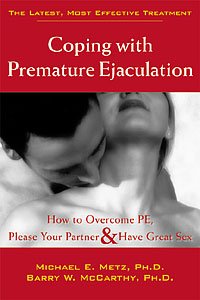
Coping With Premature Ejaculation explores a multidimensional, bio-psychological approach to dealing with this problem and strengthening your sexual relationship. This book debunks the myths of male sexual performance and analyzes male sexual desire. In it, you’ll learn about the different types of premature ejaculation and use assessment exercises to find out which you suffer from. The book then offers structured, symptom-specific treatment strategies based on psychological, relational, and physiological techniques. Find out ways to prevent relapse as well as enhance and improve your overall sexual relationship. Designed as a resource for couples, this book is a powerful tool for creating support and positive change in your relationship.

Jean D. Koehler, Ph.D., former president of the American Association of Sex Educators, Counselors, and Therapists (AASECT) lauds: “This is the most comprehensive guide to dealing with premature ejaculation I have ever seen! It addresses subtypes, cognitive, emotional, and behavioral components, medical issues, relapse, and the ever-important influence of the couple’s relationship on the cause and cure of this disorder. Drs. McCarthy and Metz have not only done a great service to couples experiencing this problem, but to sex therapists as well. I will definitely recommend the book to my clients and will incorporate its exercises in my treatment protocol.”

“This is an excellent, easy-to-read self-help book which is unique in that the treatment recommendations are individualized. Upon opening the book and reading the first pages, one immediately knows that two master therapists, with years of experience treating sexual problems, wrote this book. In a nutshell, this book is a gem.”
—Robert Segraves, M.D., Ph.D., author, Sexual Pharmacology, professor of Psychiatry at Case Western Reserve University, and editor, The Journal of Sex and Martial Therapy

“I can't say enough about this book. It's well written and takes you through the different types of PE problems. It also gives you ways to solve the PE problems. My wife is very supportive and I think this book has brought us closer together because we talked about things we haven't talked about before. There are great "couples" sections in this book to discuss. Through doing the exercises in the book I've gone from 2-3 minutes to 30 minutes in about 3 weeks time. Really, really AWESOME!!!” –Very Satisfied Amazon Reader

#3 Penis Power: The Ultimate Guide to Male Sexual Health

By Dudley Seth Danoff, M.D.

In this revolutionary guide to male sexual potency, urological surgeon Dr. Dudley S. Danoff talks candidly to men and their partners about the topics they are often too embarrassed to discuss with their doctors. Dr. Danoff debunks common myths about male sexual anatomy, including questions about penis size, stamina, and libido. Drawing upon case histories from his thirty-plus years of medical practice, he presents detailed information and practical solutions regarding issues that affect most men at some point in their lives, including: erectile dysfunction, premature ejaculation, performance anxiety, sexually transmitted diseases, prostate and testicular cancer.

In chapters like "Maximize Your Penis Power," "How to Become a Superpotent Man," and "What Women Need to Know," readers will learn how to extend sex, delay ejaculation, and boost confidence in the bedroom--banishing stress and making sex a better experience for both men and women. Penis Power is a user's guide to the male anatomy and the male mind. It's essential reading to anyone who has a penis or loves someone who does.

Leo A. Gordon, M.D., associate director of surgical education at Cedars-Sinai Medical Center describes Penis Power as “a probing and entertaining analysis of the mysteries, legends, and misconceptions surrounding the organ that has preoccupied the world ever since Eve bit the apple!”

Joe Weider, bodybuilder, fitness guru, and publisher of Men’s Fitness magazine called it, “a must read for all men who care about their physical and sexual health.”

“Particularly if you are a guy, this is a must read; it should be required reading at some point in our human development. Like it or not, the connections between our penises and our brains are an essential fact of our being; I am now convinced of that. Dr. Danoff speaks to us in a way that is easily understood, drawing on thousands of case studies in his practice. This book could save many guys (and perhaps women as well) thousands of dollars on drugs, procedures, and psychotherapy.” –Amazon Customer

Speaking of sexual health, have you 'Liked' GetLusty on Facebook yet? Have you followed us on Twitter yet? We're @getlusty there. We're also on Pinterest and Tumblr, too!


Stephanie has long believed she is a gay man trapped in a woman's body. She is a lover of good food, good sex and good grammar. A recent transplant to Chicago, she spends her free time with her super-duper-fly boyfriend and their three "kids" (2 cats, 1 dog). She has a blog she writes in every so often. She's still trying to get the whole Twitter thing down, but you can follow her @Vanderfloozie. Want to get in touch with her? Email stephanie@getlusty.com.

The ABC's of STDs': Part 2 (M-T)


There is nothing more powerful than knowledge and we want our readers to be armed with lots of it. It's the best weapon when it comes to the fight against STD's. This week we started a series on the ABC's of STD's: Part 1 (A-L). Today, it's time to continue that process with part deux. There was so much information that we had to break it up into two articles. Here is part two! Our Crimson Love reports.

* * *

M
Molluscum Contagiousum 
  • Causes: While you can contract this sexually you can also contract this while while coming into contact with a towel, clothing, or other infected objects. 
  • Symptoms: Small, flesh colored, pearl shaped, lesions with a waxy or cheesy white core form on the inner thigh, face, abdomen or genitals. When you scratch it causes them to spread and form in lines of groups called "crops"  
  • Treatment: If you have a regular immune system this usually goes away over the course of months to years. Your doctor may prescribe you a cream for the lesions or they can be surgically removed. (For more information visit, http://www.ncbi.nlm.nih.gov/pubmedhealth/PMH0001829/)
N
Non-Gonococcal Urethritis
  • Causes: E coli bacteria, chlamydia, gonorrhea, and the herpes simplex virus, injury and sensitivity to spermicides can lead to urethritis. Also, unprotected sex can cause you contract this. 
  • Symptoms: Symptoms in men are discharge, frequent urination, tenderness, itching, or swelling in the penis, blood in the urine or semen and pain during intercourse or ejaculation. Symptoms in women include, abnormal discharge, fever, stomach ache, pelvic pain and burning during urination.
  • Treatments: Antibiotics are used to treat and cure this. (For more information visit, http://www.ncbi.nlm.nih.gov/pubmedhealth/PMH0001475/)
P
Pubic Lice(Crabs)
  • Causes: Sexually transmitted or transmitted by sharing a bed or towel with an infected person.
  • Symptoms: Itching, lesions due to biting and scratching from the lice and/or a bluish-grey skin reaction
  • Treatment: A prescription shampoo is used to get rid of the lice and it's eggs. (For more information visit, http://www.ncbi.nlm.nih.gov/pubmedhealth/PMH0001844/)
S
Scabies
  • Causes: Can be contracted by sexual contact with an infected person or by other skin to skin contact. 
  • Symptoms: Itching and rash can occur due to an allergic reaction in the feces and proteins of the scabies mite. You may also find raised bumps which are burros of the female scabies mites. These skin irritations can occur on the shoulder blades, elbows, wrists, penis, armpits, nipples, waist and buttocks.
  • Treatment: Treatment for scabies is an over the counter medication that your doctor should prescribe. (For more information visit,http://www.cdc.gov/parasites/scabies/treatment.html)
Syphilis 
  • Causes:Having unprotected sex with a person infected with syphilis vaginally, anally, or otherwise is a way on contracting the disease. Also, an infected mother can pass it on to her unborn child.  
  • Symptoms: Round smooth painless lesions on the genitals are the main symptom. These lesions will heal on their own but you should still get treated because the infection will progress to a rash and lesions on other parts of the body. 
  • Treatments: This can be cured with a prescription from your doctor. If you leave this untreated the bacterial infection will worsen and spread. (For more information http://www.cdc.gov/std/syphilis/stdfact-syphilis.htm)
T
Trichomonoiasis 
  • Causes: Unprotected sexual contact with an infected person will cause the contraction of this parasite. 
  • Symptoms: symptoms affect both men and women. For women, symptoms include itching, discomfort during sex, strong odor, and abnormal vaginal discharge. For men, Itching, burning after urination or ejaculation as well as discharge are symptoms. 
  • Treatments: Treatments/cures for this are as simple as getting a prescription from your doctor. (For more information visit, http://www.ncbi.nlm.nih.gov/pubmedhealth/PMH0002307/)
All of the articles written are for you, our readers. I hope that you particularly keep this in mind to protect yourself from the scary STDs' out there. I have mentioned how you can get these and how you can get rid of them but remember the only way to avoid them is to practice safe sex, take care of your body and be nice to your immune system!!


With love from, GetLusty!

This is a guest post by our very own Crimson Love.

Crimson is our resident BDSM fetish expert. If you don't see Crimson out dining with her adoring boyfriend, you'll find her reading books on innovation or finance. Crimson is currently finishing off her Bachelor's, she is passionate about food, photography, music and especially sex--and she's not afraid to talk about it. With everyone!

Have story ideas? Get in touch with Crimson at amber@getlusty.com

The ABC's of STD's: Part 1 (A-L)

When getting under the umbrella topic of sex there will always be the topic of STD's and STI's. Sadly, not everyone knows the consequence of each STD and the proper treatment for it and prevention steps. Our Crimson Love reports.

* * *

Here at GetLusty we love our readers and want you all to be happy, healthy, and sexy. We talk a lot about love and sex but not much about what happens when a person is irresponsible or the victim of an irresponsible lover. We want you to be armed with knowledge to protect yourself! Without further pause here is are the GetLusty ABC's of STD's.

A
AIDS (Acquired Immunodeficiency Syndrome)
  • Causes: Unprotected sex or sharing of hypodermic needles resulting in HIV. This breaks down your immune system and lessens T-cell (Cells that send signals to your immune system, alerting it of intruders) production.
  • Signs and Symptoms: The symptoms of AIDS are usually comparable to having a really bad flue.  
  • Treatments: There is no cure for AIDS yet, however there are medications for HIV to slow the reproduction of the virus in the body. (For more information go to http://aids.gov/ or http://www.ucsfhealth.org/conditions/aids/treatment.html)
C
Chancroid
  • Causes: Sexually transmitted when skin comes in contact with an open sore
  • Signs and symptoms: You may experience raised, puss filled bumps and painful lymph glands in the groin.
  • Treatments: Chancroid can be cured with successful treatment, in addition to stoping transmission to others and banishing symptoms. (For more information visit, http://www.idph.state.il.us/public/hb/hbchancroid.htm)
Chlymidia
  • Causes: Sexually transmitted through unprotected sex orally, anally or vaginally. 
  • Signs and symptoms: Chlymidia is usually asymptomatic for women but when symptoms do occur they are usually burning urination or abnormal vaginal discharge. The same symptoms also occur along with the possibility of itching or swollen testicles. 
  • Treatments: This STD can be cured properly and easily with antibiotics. ( For more information visit http://www.cdc.gov/std/chlamydia/stdfact-chlamydia.htm )
G
Genital Warts
  • Causes: A Sexually transmitted HPV (Human Papilloma Virus) infection involving the anus, vagina, mouth or penis. 
  • Sign and Symptoms: You may see raised cauliflower looking bumps, flesh  colored spots that are raised or flat. For women you can get them inside your vagina, on your cervix in your anus or on the outside of your vagina or anus. For men,  you can get them on your penis, in or on your anus, thighs, groin or scrotum. You can also get them on your lips, mouth, tongue and throat. Also, sometime you may have warts and not see them.
  • Treatments: There are many treatment options for genital warts. They include, wart removal surgery, medication you have to take orally or apply regularly, or an in office skin treatments done by your doctor. (For more information visit,  http://www.ncbi.nlm.nih.gov/pubmedhealth/PMH0001889/)
Gonorrhea
  • Causes: Sexually transmitted from an infected person. 
  • Signs and Symptoms: It is possible for some people to have no symptoms at all. However, in men symptoms can include enlarge testicles, burning during urination and yellow, white, or green discharge. In women symptoms can be mild but,  increased levels of discharge, bleeding in between periods and burning during urination. If the infection is in the anus it can cause bloody stool, painful bowl movements or discharge. 
  • Treatments: Gonorrhea can be cured with the right medication however, the disease is developing more and more drug-resistant strains. (For more information, visit  http://www.cdc.gov/std/gonorrhea/stdfact-gonorrhea.htm)
H
Hepatitis A, B, C
  • Causes: While hepatitis can be caused by many other factors like alcoholism some of the strains can be transmitted sexually.
  • Symptoms: Loss of appetite, weight loss, nausea, fever, stomach pain, dark urine.
  • Treatments: Your doctor will discuss treatments depending on your condition and how advanced the disease. (For more information please visit, http://www.ncbi.nlm.nih.gov/pubmedhealth/PMH0002139/)
HIV
  • Causes: Transmitted sexually through unprotected sexual contact, needle sharing, or occupational exposure (Anyone in the medical field should take special care and always wear gloves. Doctors, nurses, EMTs, nurses ect) Also, I feel it important to mention that Pre-exposure to other STDs can increase you susceptibility to contracting HIV because it's easier to contract with a weakened immune system. 
  • Symptoms: Usually symptoms of HIV are non-exsistent until ir progresses towards AIDS. If there any symptoms at all it feels like the worst possible flu. Muscle aches, fever, soar throat, chills, rash, fatigue, ect. 
  • Treatments: You cannot cure HIV as of yet but you can keep it in check with medications prescribed by your Dr. (For more information visit, http://aids.gov/
HPV (Genital)
  • Causes: Transmitted sexually through unprotected sex of the anus and genitals. 
  • Symptoms: Genital warts, warts in the throat and different types of cancers are symptoms of HPV. However, most people who are infected don't show any signs or symptoms. 
  • Treatments: There are vaccines available for HPV. These vaccines are used as preventative measures however, once contracted if your body cannot fight off the virus an infection will happen. HPV cannot be cured because it is a virus. Like all other viruses, if your body is strong enough it will clear itself like it does with the flue of chickenpox. (For more information http://www.cdc.gov/std/hpv/stdfact-hpv.htm )
Herpes
  • Causes: Transmitted sexually from unprotected sex with a person infected with Herpes simplex virus 1 or Herpes simplex virus 2.
  • Symptoms: Usually symptoms of herpes of non-exsisten to mild and are sometimes mistaken for other skin conditions. Visible symptoms of herpes are blisters the genitals that break and become soars. Also, when a person has their first outbreak they can experience flu like symptoms.
  • Treatments: Herpes cannot be cured but you can take antiviral drugs to shorten the duration of outbreaks and transmission to others. Your doctor may also suggest taking immune builders, and keeping stress levels low to keep outbreaks to a  minimum.  (For more information visit, http://www.cdc.gov/std/herpes/STDFact-Herpes.htm)
L
Lymphogranuloma

  • Causes: Transmitted through sexual contact with an infected person. 
  • Symptoms: This is a bacterial infection that attacks the lymphatic system so you may get drainage from your lymph nodes, pain and/or swelling n the groin area, swelling in the labia, painful bowl movements, and blood or pus from the rectum.
  • Treatments: This is curable with the right antibiotics and care. (For more information visit,http://www.ncbi.nlm.nih.gov/pubmedhealth/PMH0001658/)
We love our readers and want you to stay safe and healthy! Please be aware, take your sexual health serious and get regular check ups. 

With love from, GetLusty!

This is a guest post by our very own Crimson Love.

Crimson is our resident BDSM fetish expert. If you don't see Crimson out dining with her adoring boyfriend, you'll find her reading books on innovation or finance. Crimson is currently finishing off her Bachelor's, she is passionate about food, photography, music and especially sex--and she's not afraid to talk about it. With everyone!

Have story ideas? Get in touch with Crimson at amber@getlusty.com

Are You Checking These For Your Health?

This month is breast cancer awareness month so the theme of getting checked out doesn't fall short here at GetLusty. A constant topic of discussion is sexual health and overall health. We talk about everything from our own issues to questions we get from our readers. Health and sexual health is very important so get checked out. Protect your body. Learn how as Crimson Love reports.

* * *

We want to encourage you to always get checked out. Here are some exams to remember to get.

Heart health checks 

An important factor in sex is your heart whether you think about it or not, so take care of it. If you have a family history of it, get checked for high blood pressure! You should also get your cholesterol checked. Have your doctor check the levels of good and bad cholesterol to be more thorough. 

Colonoscopy 

Colon cancer is something men and women can both get. Around the age of 50 you should receive these exams bi-anually. However, according to WebMd, your doctor may recommend more frequent checkups if you have a family history of colon cancer. 

STD/STI tests 

With a resistant strain of gonorrhea out there and an epidemic in the works it is important to make sure that you get regular STD (sexually transmitted disease) and STI checks (sexually transmitted infection). In a committed relationship regular STD and STI checks should happen annually but, HIV tests should happen every six months in my opinion. Especially if you are not using protection.
 
For Women

Breast exams - Ladies, here are different kinds of breast exams to get and they should all be done (not all at once). According to the CDC (Center for Disease Control), in your 40s you should start getting mammograms bi-annually depending on your families history. It's basically an X-ray for your boobs. It's used for early detection of breast cancer. You should also get annual clinical breast exams. These are when your doctor uses his or her hands to feel for lumps, and abnormal changes in your breasts. Another option is a self administered breast exam. It may sound intimidating but there are Youtube videos and websites  that will help you through the process.

Pap smears - You should start receiving these pap smears annually, within two years of you becoming sexually active up until your 70, according the Better Health Channel. This is a critical test that can detect warning signs of cervical cancer which can be caused by HPV and other factors like genetics.

Bone Density - It's very important that you get bone density tests when you're an older woman. This is because menopause is a "risk factor" to osteoporosis, according to the Better Health Channel.

For Men

Testicular Exams - Gents between 15 and 40 should get annual exams for testicular cancer. After age 40, the risk of testicular cancer drops but you should still receive regular exams bi-annually.

Prostate Exams - Gentlemen we know that this might make you squirm a little but, it's important. According to WebMd, you can either receive the digital rectal exam or the prostate specific antigen test (PSA test). While the PSA may seem easier and harmless the chances of getting a false positive are higher than they should be.

Here at GetLusty we love our readers and want you to be happy healthy and sexy. So, do you and us a favor by getting your annual and bi-annual exams. With love from, GetLusty!

This is a guest post by our very own Crimson Love.

Crimson is our resident BDSM fetish expert. If you don't see Crimson out dining with her adoring boyfriend, you'll find her reading books on innovation or finance. Crimson is currently finishing off her Bachelor's, she is passionate about food, photography, music and especially sex--and she's not afraid to talk about it. With everyone!

Have story ideas? Get in touch with Crimson at amber@getlusty.com


How Do I Disclose My STD?

Most people over the course of their lifetime have gotten STDs (sexually transmitted disease also known as STI with the I meaning infection). In fact, according to the Center for Disease Control STD rates have grown constantly since 1990. Below is a chart detailing Chlamydia rates from 1990 to 2010.  They may have had a pre-existing condition, or don't even know they have a STD, and doesn't necessarily mean infidelity. This isn't to worry you, but it's recommended to get checked every year for STDs.

Both partners should be able to communicate openly and honestly without fear of humiliation or rejection. When you first meet someone though, honesty can be difficult.

Fear of rejection and being being hurt can stop anyone from disclosing truth about themselves. In the reader question below, Nadine answers a question about how to disclose that you have a STI to a potential sexual partner. Nadine Thornhill reports.

* * *

Recently, a reader Sadie* wrote in with the following question:

"Dear Nadine,

I feel a bit isolated on the topic of herpes. I have been living with it for years, yet since I first disclosed it years ago to a partner, he reacted very negatively and told me to get out of his life. I was shattered. Months later, he knocks on my door and he says 'Herpes is not a big deal, please take me back.' But I couldn’t take him back. He didn’t want to use a condom and my fear is if I gave it to him, he may hold me responsible or he may leave me again. I chose not to be intimate with him anymore. I have been very careful and have become more selective in chosing a partner. I haven’t met anyone yet to disclose herpes. Yet, there is a fear inside of me and I get anxious about the idea of telling someone I may like. How do I tell him?"

This is a great question. Finding the right time and the right way to disclose an STI is a challenge many sexually active people face. But before share my two cents, I want to make it clear that this is just one gal’s opinion. Some of you may disagree or have different/additional advice. If so, I welcome your thoughts – feel free to chime in anonymously – in the comments.

For my money, I gotta say that I think Sadie did the right thing disclosing her status to her first partner. And while ultimately I believe that we all have a right to decide which sexual risks will and will not take, I wish Sadie’s partner hadn’t been a shaming douche about it. Because for many people living with an STI that is the fear. What if this person I really like rejects me?

And it’s not just the fear of rejection, but the fear of being judged and deemed dirty or bad. That fear is legit. Despite the fact that human beings transmit infections and develop illnesses ALL THE TIME, the idea that only “bad” people get sick from sex still persists. It’s bullshit. And it’s makes disclosure very difficult.

But even though it turned out badly the last time, I still think Sadie did the right thing. The fact that her partner reacted badly isn’t about her, it’s about them. I don’t think Sadie needs to disclose her status right out of the gate. If you’re still getting to know someone and nothing sexual is happening, I think it’s all right to bide your time.

However, if and when Sadie feels that physical intimacy is imminent, I think that disclosing her STI status is the responsible thing to do.

Ideally, it’s not a conversation to have during a hot and heavy make-out session. Probably better to arrange a specific time and place where she and her partner can have a private conversation. It might help to prepare what she wants to say beforehand. I’m not talking about a formal address on index cards, but practicing an opening statement a couple of times in the mirror can make it easier to say what she needs to say in a straightforward manner.

It’s likely that her partner may have questions and concerns. It’s also very possible that her partner will realize that he’s met an honest person with a shit ton of integrity – a person who’s worth sticking around for. Because STIs happen and partners who are willing, figure it out.

So my advice to you Sadie, is to keep doing what you’re doing. I can only image how much that first rejection hurt. But not everyone is like your first partner. There are people who understand that STIs happen, who won’t judge you for it having one. That’s the type of partner you deserve to be with and that’s the partner you can find.

Do you have advice about how best to tell someone you have an STI? Have you had to disclose your status to a partner? Have you had a partner disclose their status to you? The comment section is yours!

*Name changed at the request of the reader. This was originally posted on Adorkable Undies.

Nadine is a sexual health educator, playwright, poet, burlesque performer, partner and parent living in Ottawa, Ontario. The plays and poetry she creates tend toward subjects such as clitorises, vibrators and non-monogamy.

She enjoys candy, fashion and dreck television. She does not care for pants. Find her on Twitter @NadineThornhill. She also blogs on Adorkable Undies. Find her blog on Facebook and Pinterest.
Copyright © 2011. thethrifters - All Rights Reserved
Proudly powered by Blogger